
Relationship-aware sequences
LinkedIn relationship-building sequences: 5 examples that earn the next step
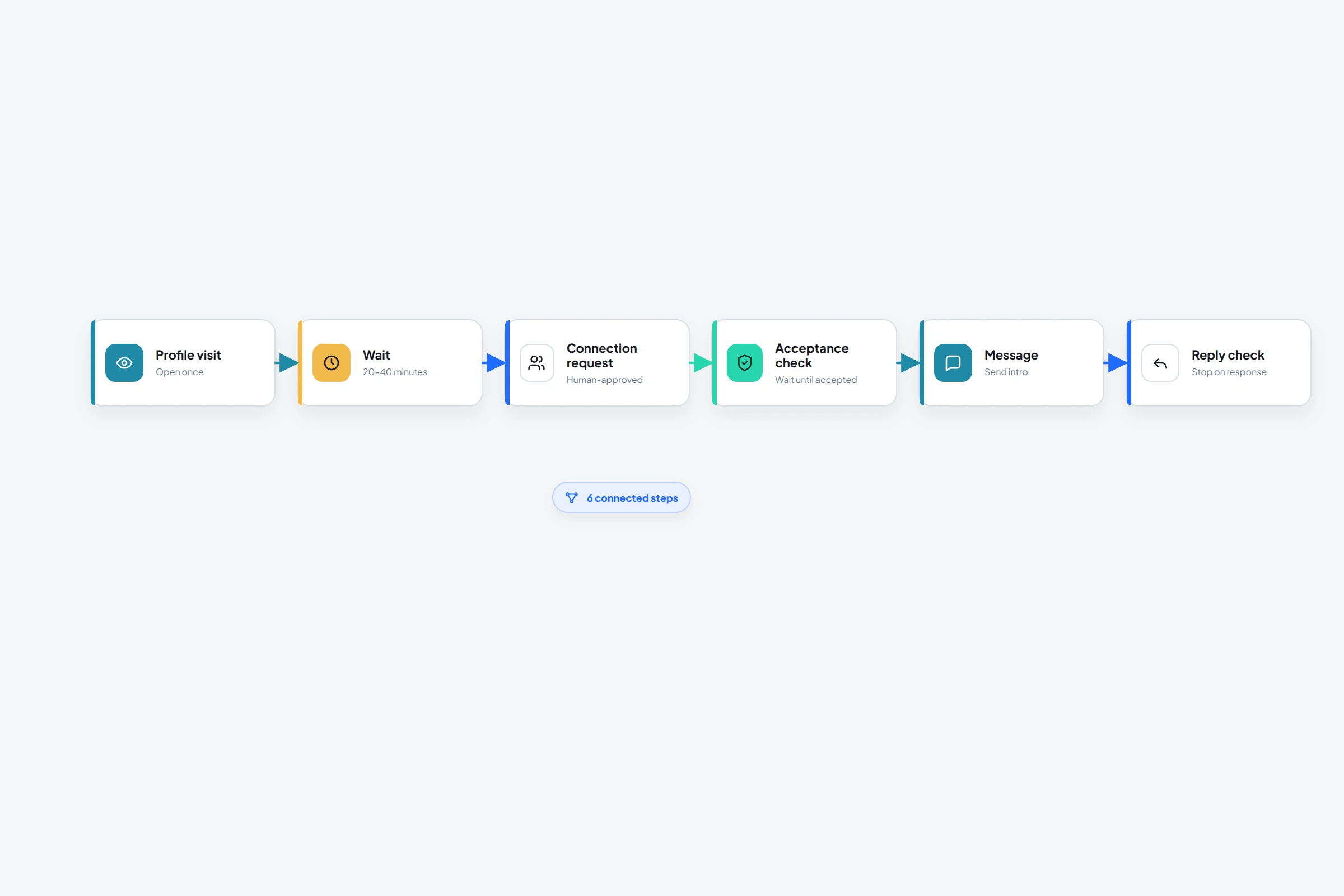
A profile visit, a useful comment, a connection request, and a follow-up can look like four completed steps inside a LinkedIn workflow. From the recipient's side, they may look like four actions they never asked for. Both views are accurate. The gap between them explains why so many relationship-first sequences still feel cold.
Automation is good at recording what the sender did. A relationship changes only when the other person adds information: an acceptance, a reply, a request, a conversation at an event, or consent to an introduction. The sequence should advance on that new state, not because another date arrived on the calendar.
01
A sequence contains two kinds of state
The mistake in a relationship-building sequence is usually not the message. It is the model underneath the message. A completed action is treated as progress even when every action came from the sender.
LinkedIn's current connection guidance says connecting works best when there is a clear professional reason, including meeting at an event or continuing a conversation. That guidance points to three different states a workflow should keep separate.
- 01
Sender context
You found a relevant post, reviewed a profile, attended an event, or noticed a role change. You now have a reason to decide whether contact makes sense. The other person has not done anything.
- 02
Recipient evidence
They accept, reply, request a resource, continue an event discussion, or consent to an introduction. The next message can respond to something they actually contributed.
- 03
Business relevance
They describe a problem, priority, or question connected to your work. Only now can a commercial next step follow the conversation rather than interrupt it.
02
Example 1: a post gives you a subject, not permission
Someone else's post is useful because it narrows the subject of a possible conversation. It does not tell you that the author needs your product, wants a private message, or will remember your name. A sequence that confuses those claims turns public engagement into theater.
LinkedIn's invitation best practices emphasize relevant, recognizable connections. Start by reading the full post and checking the person's role. If you cannot add anything useful in public, skip the comment. Silence is a better introduction than praise written only to manufacture familiarity.
- 01
Choose the right channel
If your contribution extends the post, leave it in the thread. If you only want to follow the author's work, follow. Send an invitation when you can state a truthful professional reason without converting the note into a pitch.
- 02
Connect around the exact idea
Example: “Hi Priya, your point about checking for replies immediately before each follow-up was useful. I work on the same problem from the workflow side. Happy to connect.” The post supplies context; it does not supply a sales claim.
- 03
Let acceptance open one question
Ask about the mechanism discussed in the post: “You mentioned reps still check replies manually. Is the harder part catching the reply, or getting every active sequence to stop?” Check for a reply before any later message. If there is no response, the useful comment still did its job.
03
Example 2: an event gives you shared context
A webinar, conference session, cohort, Slack discussion, or in-person meeting begins one state further along. Both people encountered the same event, and sometimes they spoke. The asset here is memory, which decays; delaying the invitation for a week of scheduled likes destroys the strongest context you have.
- 01
Use the memory while it is useful
“Hi Sam, I was in your partner-onboarding breakout this morning. Your point about tracking handoffs outside Slack changed how I was framing the problem. Good to meet you.”
- 02
Resume the unfinished topic
After acceptance: “You mentioned the handoff fails when nobody owns the exception. Are you solving that in the CRM, or is the team still coordinating it in Slack?” A call is reasonable if the original exchange included an agreement to continue. Otherwise, wait for a substantive reply.
04
Example 3: an inbound reaction is evidence, but weak evidence
A reaction to your post reverses the direction of the first signal: the other person did something. That matters, but the strength of the signal varies. A like may mean agreement, support, curiosity, or almost nothing. A specific question or resource request tells you much more.
Importing every engager into the same campaign is a targeting error disguised as follow-up. Review the person's role and actual contribution. Answer publicly when the thread is the natural place for the conversation. Move privately when they request a resource, share something that needs a private answer, or invite the next step.
- 01
Preserve the meaning of the inbound action
When a resource was requested: “Thanks for the comment, Lena. Here is the reply-stop flow you asked for: [link]. The part most teams miss is the second check after a long wait. Tell me if that is the failure you are seeing too.”
- 02
Let their response choose the branch
If Lena discusses the failure, continue manually. If she only wanted the resource, delivery may be the end. The sequence should not quietly replace her request with your preferred outcome.
05
Example 4: an introduction transfers context, not trust
LinkedIn's social-selling guidance distinguishes one-size-fits-all outreach from warm introductions and pertinent conversations. A mutual connection can explain why two people should talk and confirm that the introduction is welcome. They cannot transfer unlimited trust.
Ask the introducer whether the connection makes sense and what context they are comfortable sharing. When they make the bridge, reply inside that context.
- 01
Reply in the shared context
“Thanks for connecting us, Elena. Marcus, Elena said you are rebuilding the partner handoff between sales and onboarding. Which part is creating more rework right now: the data transfer or the ownership change?”
- 02
Protect the introducer's reputation
If Marcus engages, the conversation now has its own state. If he does not respond or says the timing is wrong, stop. Enrolling a referred person in a generic chain spends the introducer's reputation on messages they never endorsed.
06
Example 5: a dormant relationship reduces explanation, not obligation
A former customer, past collaborator, or old sales conversation comes with history. That history lowers the cost of explaining who you are. It does not create permanent intent. The useful question is what changed since the last conversation.
- 01
Start from the last known state
“Last time we spoke, you were moving onboarding from a spreadsheet into HubSpot. Did the migration settle down, or did the exception handling move somewhere else?”
- 02
Add one new observation
If there is no reply: “I asked because we just mapped a handoff where the happy path lived in HubSpot but every exception still went through Slack. I can send the map if that is familiar.”
- 03
Close the loop
End after that second touch without a reply. “Just checking in” asks the recipient to reconstruct your reason for writing, while guilt and persistence try to turn history into obligation. Neither adds new information.
07
Automation belongs at the state transitions
OutreachGenie can make observable state explicit. Start with the source context and current connection state. Use Visit profile, Follow profile, or Check profile active when the result changes a decision. Add Send connection request only where an invitation fits, then place When user accepts before a first-degree message.
Use Message sequence for an initial first-degree message and timed follow-ups. It checks for replies when each follow-up delay ends and stops that prospect's sequence on a tracked or detected reply. Standalone Check reply has no manual review gate or automatic replied/no-reply branch: completion schedules the next node automatically. A person cannot rely on inspecting its result before a later Send message runs.
To interrupt an active campaign for review, use Pause campaign or Stop campaign in campaign settings and confirm the paused or stopped status. These controls affect the entire campaign; a message already in flight may still complete. There is no per-prospect stop control in the campaign prospect panel. Editorial judgments and responses to replies remain human decisions.
- Label each transition with the evidence required to cross it
- Keep the post, event, introducer, or prior conversation attached to the prospect record
- Review accepted, pending, already connected, replied, and no-reply states before choosing the next action
- Remove actions that create activity without changing a later decision
08
The test is whether the next message knows something new
Read the flow from the recipient's side. A visit followed by a like, invitation, instant message, and calendar link may look gradual on the canvas. It can still arrive as one scheduled pitch because the later messages know nothing that the earlier ones learned.
Pause at every arrow and ask what changed. If the person supplied new context, the next step can answer it. If only the date changed, the sequence is not building a relationship. It is spacing out a campaign.
That conclusion has a useful limit. A sequence does not need a reply before every operational step; research, reminders, and a single unanswered follow-up can still be sensible. The requirement is narrower: do not claim that sender activity created reciprocal intent. Until the recipient contributes something, design the workflow as careful outreach rather than a relationship that does not yet exist.
Common questions
Questions that come up in practice
What is a LinkedIn relationship-building sequence?
It is a LinkedIn workflow that keeps sender context separate from recipient evidence. Research and public engagement can prepare an approach, while acceptance, replies, requests, and introductions determine whether the conversation advances or stops.
How long should a relationship-building sequence run?
There is no universal duration. A wait should give someone time to notice, accept, or reply; it does not create interest by itself. These examples allow at most one useful unanswered follow-up before the automated path ends.
Should I engage with posts before sending a connection request?
Engage when the contribution is useful in the public thread even if no private conversation follows. Skip generic praise and scheduled reactions. A direct, truthful invitation can be better than pretending several public actions created familiarity.
Is someone who liked my post a warm lead?
No. A reaction is recipient evidence, but it is weak and ambiguous. A specific comment, question, or resource request carries more information. Review the person and the substance of the engagement before choosing the next step.
Can OutreachGenie stop a sequence when someone replies?
Yes. Message sequence stops that prospect's sequence on a tracked or detected reply and checks before delayed follow-ups. Standalone Check reply has no manual review gate or automatic replied/no-reply branch; completion schedules the next node automatically. Use Message sequence for reply-aware follow-ups and let a person handle the response. A message already in flight may still complete.
Research used for this guide
- Various ways to connect with people on LinkedIn | LinkedIn Help
- Connecting With Other Members: Best Practices | LinkedIn Help
- Invitation limit reached | LinkedIn Help
- Automated activity on LinkedIn | LinkedIn Help
- Social Selling: What Is Social Selling and Why Is It Important? | LinkedIn Sales Solutions
- From SSI to AI | LinkedIn Sales Navigator
- What is Social Selling and How Does It Work? | Salesforce
- Six approaches to follow-up sales emails | Gong Labs
- Brynne Tillman on authentic social selling | LinkedIn
- Why social selling is not just about LinkedIn | Morgan J Ingram on LinkedIn
Try the workflow