
Audience selection
How to define an ideal customer profile for LinkedIn outreach
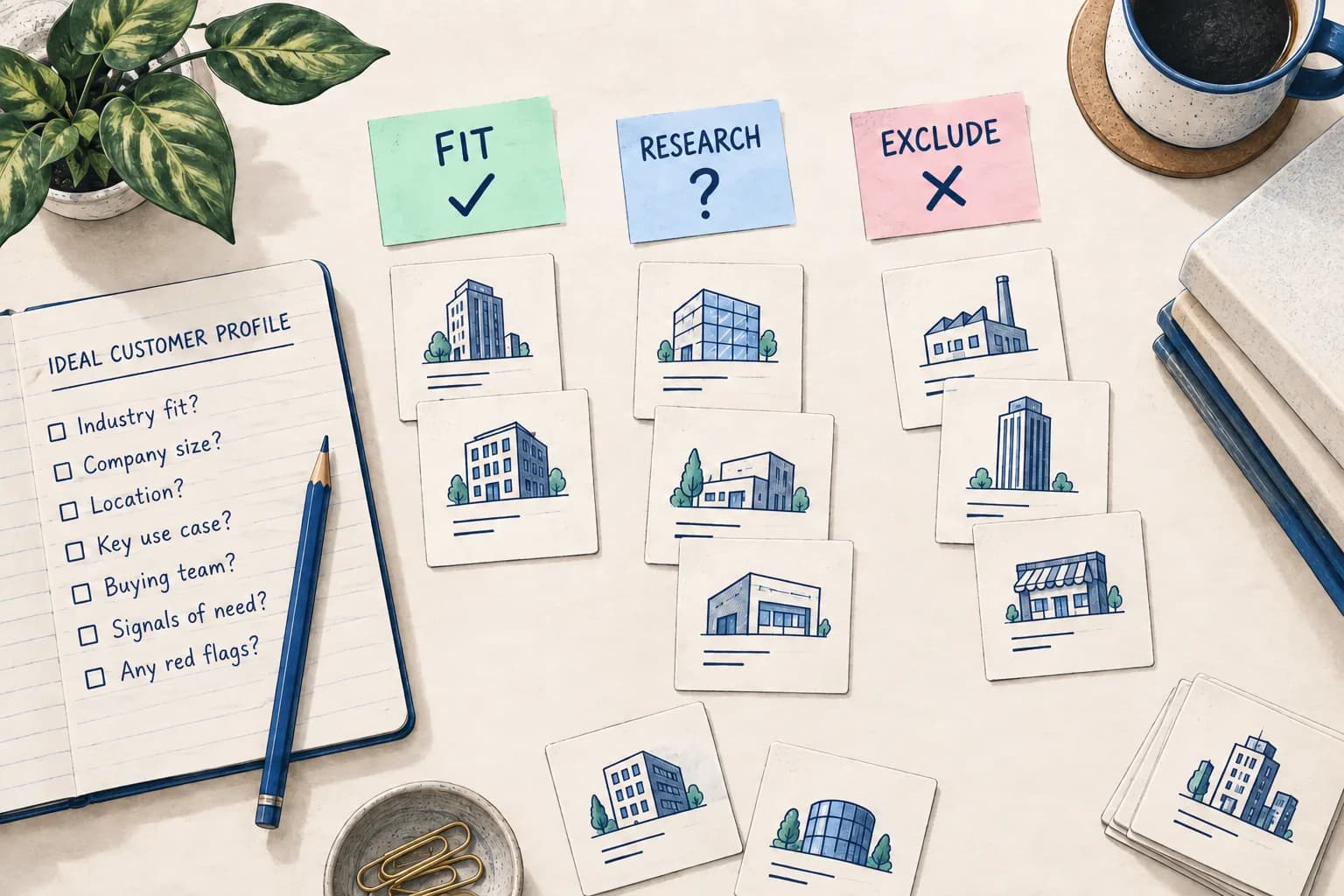
A list of 500 people can look precise: every row has a name, a title, and a company. The uncertainty is hidden in why those people belong on the list. If the only answer is that they are senior enough to buy, the research is unfinished.
An ideal customer profile for LinkedIn outreach should make that decision easier. It describes the kinds of companies that can get sustained value from your offer at a cost your business can support. The useful version fits on a working sheet and changes which accounts you pursue. Here's how to build one, including what to do when you have little customer data.
01
What an ICP can tell you before a conversation
For B2B prospecting, keep the ICP at company level. It might specify a business model, a size range, an operating environment, and the problem your offer is designed to address. A buyer persona concerns the people involved: the person doing the work, the person who approves spending, and anyone who can block the change.
Timing is a separate question. A company can fit your market for years without needing your service this month. A new operations hire is evidence that a job changed or opened. It does not prove a budget, dissatisfaction with a supplier, or permission to pitch.
This distinction affects what goes into a prospect record. Publicly observable traits can support an initial targeting decision. Budget, internal urgency, and approval process often remain questions for discovery. LinkedIn search can surface candidates; it cannot answer those questions for them.
| Decision | Example | What remains unknown |
|---|---|---|
| Does the account fit? | A B2B services firm with a delivery team and multiple client handoffs | Whether the handoffs cause a costly problem |
| Who might understand the problem? | The operations lead responsible for delivery | Whether that person controls the budget |
| Is there a reason to investigate now? | A current job listing describes new client-onboarding responsibilities | Whether the firm wants outside help |
02
Start with the work you can deliver
Before choosing an industry, write down the outcome you sell and the conditions needed to produce it. An operations consultancy might help a services business reduce missed client handoffs. To deliver that work, it needs access to the existing process, an internal owner, and a team willing to adopt the changes. A company can afford the project and still lack those conditions.
List your delivery boundaries too: regions and languages you can support, systems you can work with, project sizes you can handle, and requirements you cannot meet. These are practical exclusions. They prevent a recognizable company name or a large potential contract from outweighing a poor delivery fit.
Check the economics at this stage. Consider implementation effort, support time, and the cost of acquiring the customer. A large first invoice does not establish a good customer relationship if the work repeatedly loses money. Use your actual costs; a competitor's average deal size is not a suitable substitute.
03
Compare successful customers with the difficult cases
If you have customer history, make one row per account. Include retained customers, early cancellations, lost opportunities, and projects that took substantially more work than expected. Record the problem purchased, company type, initial scope, sales effort, delivery effort, and what happened afterward. Keep the time period comparable: a new customer has not had the same chance to renew as an older one.
Look for traits that distinguish useful outcomes from poor ones. If most customers are agencies, that may simply reflect where you have spent your sales time. It does not establish that agencies are your best segment. Compare outcomes within the audience you actually reached and note the groups you have barely tested.
Then speak with customers and people involved in lost deals when they are willing. Ask what changed before they looked for help, what alternative they considered, who handled approval, and what made implementation difficult. Their answers can correct a pattern that looked convincing in a spreadsheet. Avoid steering them toward the problem you hoped they had.
04
Use a working hypothesis if you have no customers yet
Start with one deliverable problem and a plausible group that experiences it. Mark the profile as a hypothesis. Review public company material and talk to potential buyers about how they handle the work today. A service page, a job advertisement, or a public discussion can give you a reason to ask; none is a substitute for the answer.
Keep a small adjacent group in the research so you can challenge the first definition. For example, compare client handoffs at a services firm with those at a software company before assuming the same offer suits both. Document what would make you drop or widen the segment.
You do not need an elaborate persona with an invented name, age, or personality. You need evidence that the problem exists, a credible way to reach the people involved, and an offer you can deliver. Early conversations test those assumptions. They do not establish a market-wide conversion rate.
05
An ICP worksheet you can use without a scoring tool
The example below is fictional. It describes an operations consultancy's initial targeting hypothesis, not OutreachGenie's customer data. Replace the choices with evidence from your own business. Each criterion needs a reason: if removing it would not change your decision, it may not belong in the profile.
Use three evidence states: confirmed, contradicted, and unknown. A missing headcount is unknown. A verified unsupported system is a contradiction. Do not award enough points for funding, activity, or a senior title to cancel a requirement you cannot meet.
| Field | Illustrative choice | How to check it |
|---|---|---|
| Problem and offer | Help services teams make client handoffs reliable | Compare past delivery outcomes or interview potential buyers |
| Company scope | B2B services firms with a distinct client-delivery team | Company website, current team roles, and business model |
| Initial size hypothesis | 20 to 100 employees | Company information; verify rather than treat estimates as exact |
| Delivery boundary | Remote English-language delivery within supported working hours | Confirm operational requirements during discovery |
| Possible first contact | Operations or client-delivery lead | Current responsibilities, not seniority alone |
| Reason to research now | A new service launch or delivery-team expansion | Dated company announcement or current job listing |
| Hard exclusions | Work requires unsupported systems or an on-site presence the consultancy cannot provide | Published requirements or a direct answer |
| Still to learn | Problem cost, internal owner, budget, and change timetable | Ask in a relevant conversation; do not infer from funding |
| Evidence record | Source URL, date checked, observation, and uncertainty | A reviewer can find the same evidence |
| Review trigger | Repeated delivery mismatch or new evidence against the size range | Compare outcomes and revise the specific rule |
06
Turn the profile into LinkedIn search filters
Start with the attributes you can actually search. Ordinary LinkedIn people search offers filters such as location, current company, and industry. Sales Navigator provides separate lead and account filters, including company headcount and role criteria. Some capabilities depend on the subscription. Check the options available in your account rather than assuming every guide describes the same interface.
For the consultancy example, first identify relevant services companies, then look for current operations or delivery roles within those accounts. If the available headcount bands do not match your chosen range, use a broader filter and check candidates individually. Where a person lives and where a company is headquartered also answer different questions; neither alone establishes working-hour compatibility.
Inspect the results before adding more filters. If the search keeps returning the wrong business model, refine that part of the query. If the companies fit but the contacts do not, work on roles and titles. Preserve the search criteria and date so you can explain how the list was built.
07
Make an inclusion decision on actual accounts
Apply the same worksheet to each candidate. Write the observation before the conclusion. For example, a company hiring a delivery coordinator is a fact you can check. Saying its handoffs are failing goes beyond that fact. The appropriate next step may be a question about the new role, not a claim that you understand its internal problems.
These fictional cases show how one profile can produce different actions. Research status should remain separate from campaign membership: an unresolved record should not enter an active outreach sequence just because it was imported.
| Candidate | Evidence available | Decision |
|---|---|---|
| Account A | Services business, delivery team, supported location; current announcement of a new service | Account fit supported. Research the relevant owner and ask about the change; urgency remains unknown. |
| Account B | Relevant business and title, but company size and operating requirements are unclear | Hold for research. Missing evidence is not a failed criterion or permission to guess. |
| Account C | Company fits the size range, but the project requires daily on-site delivery outside the supported region | Exclude from this offer. Activity and company size cannot fix the delivery mismatch. |
08
Test the list before testing the message
A small manual review can expose a bad search quickly. Suppose you inspect 20 accounts selected before review, using the same written rules. You find 11 supported fits, five clear exclusions, and four unresolved cases. That is 55% supported fit, 25% excluded, and 20% unknown. The figures add up to the entire reviewed set; unknowns have not quietly become qualified leads.
This is illustrative arithmetic, not a benchmark or a recommendation to contact all 20. The result tells you to inspect the five exclusions and resolve the four unknowns. If most exclusions share the same wrong industry, improve the search. If reviewers disagree over what counts as a delivery team, clarify the rule. A small review can diagnose those problems without proving the whole market's fit rate.
Once the list is review-ready, track conversations separately. Use a consistent observation window and record unique people contacted, replies, relevant conversations, agreed next steps, and eventual customer outcomes. A negative reply is still a reply; it is not evidence of demand. Keep delivery errors and unsent actions out of a sent-message denominator.
Do not change the audience, offer, message, and timing together and then attribute the result to the ICP. Compare reasonably similar cohorts, note remaining differences, and follow the accounts beyond the first response. The segment that replies most may still be expensive to serve.
09
Keep the reasoning beside the prospect in OutreachGenie
OutreachGenie provides prospect lists, profile records, custom fields, and notes. Use those records to preserve your review decision and the context behind it. For example, maintain a research list separately from a reviewed list, and give each a name that identifies the audience and review period.
A useful note is short: source URL and date; the business fact observed; why it relates to your offer; what still needs checking; and the next action. Do not paste entire personal profiles or speculate about sensitive personal characteristics. Keep only the professional information needed for the work.
This is a manual qualification practice supported by a workspace. It is not a claim that OutreachGenie predicts buying intent or automatically validates an ICP. A targeted list also does not remove LinkedIn's restrictions on third-party scraping or automated activity. Review those rules before choosing how to collect or contact prospects, and honor a person's request not to be contacted.
10
Revise the rule that the evidence contradicts
Refresh a stale contact record without assuming the whole ICP has changed. A person moving jobs is a data-maintenance issue. Several otherwise suitable accounts needing a service you cannot deliver is a reason to revisit the offer or its exclusions. Low response to an unclear message calls for a different investigation.
Give the profile an owner and a review date. Review sooner when your service changes, delivery costs rise, or repeated conversations contradict an important assumption. A quarterly discussion can be a useful routine, but the calendar is less important than having evidence to review.
Your next step is to write the first version and apply it to a small, predetermined set of accounts. Keep the rejected and unresolved cases. Those rows are often the most useful part of the exercise: they show exactly what the next round of research needs to answer.
Common questions
Questions that come up in practice
How narrow should a LinkedIn ICP be?
Narrow enough that another person can apply the rules consistently, with a reason for each criterion. Check whether enough reachable, suitable accounts remain to support your sales goals. Avoid adding filters simply because they are available. Test adjacent groups separately when evidence is limited.
Should company size be a hard requirement?
Only when it reflects a real delivery or economic constraint. Otherwise treat the range as a hypothesis to test. Two companies with the same headcount can have very different processes, budgets, and purchasing needs.
Can I build an ICP without Sales Navigator?
Yes. Customer records, interviews, public company information, and ordinary LinkedIn search can support the work. Paid filters may reduce search effort, but they do not establish that the underlying targeting decision is sound.
Does commenting on a relevant post make someone an ideal prospect?
It provides context for research. Check the person's company and responsibilities, read what the comment actually says, and keep their buying interest unknown unless they express it. A reaction is weaker evidence than a direct request for help.
How many ICPs should a small team start with?
Start with the number of distinct offers and audiences you can research, message, and evaluate properly. One focused hypothesis is often easier to learn from than several loosely defined groups. Add another when the evidence and team capacity justify separate treatment.
What is a good ICP match rate?
There is no universal percentage for a manually reviewed prospect list. The result depends on the criteria, source, and amount of missing information. Report supported fits, exclusions, and unknowns separately, then improve the source or decision rules that cause avoidable errors.
Research used for this guide
- Sales Navigator lead and account search filter definitions | LinkedIn Help
- Search for people on LinkedIn | LinkedIn Help
- Practitioner posts on ICP identification | LinkedIn
- A Guide to Building Your Dynamic Ideal Customer Profile | LinkedIn Sales Navigator Community
- Automated activity on LinkedIn | LinkedIn Help
Try the workflow